
Out Now! The Renewables-Based Economy (RBE) Tracker launched 18 June 2026.
Renewables are scaling rapidly, but the wider economy is not changing at the same pace. The first edition of REN21’s Renewables-Based Economy Tracker finds growing gaps in infrastructure, policy, investment and energy system readiness that are slowing progress towards a renewables-based economy and a more secure world.
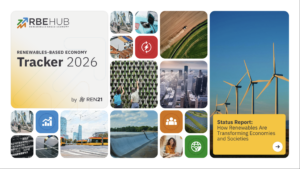
Developed as part of REN21’s new Renewables-Based Economy Hub, the RBE Tracker is the first global tool designed to measure how renewable energy is reshaping economies through its impacts on energy security, industry, investment, infrastructure, resilience and broader socio-economic outcomes. This tool provides strategic guidance on the energy transition for policymakers.
RBE Tracker links and downloads:
- RBE Tracker: Available Here
- Report PDF: Available Here
- RBE Glossary: Available Here
- Indicator Framework: Available Here
- Data Gaps: Available Here
- Key Stats: Available Here
- Press Release: Arabic | Chinese | English | French | German | Spanish
Case Studies
Denmark
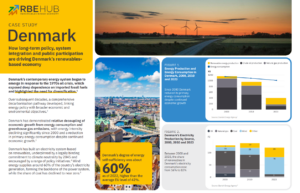
Denmark’s contemporary energy system began to emerge in response to the 1970s oil crisis, which exposed deep dependence on imported fossil fuels and highlighted the need for diversification.
Over subsequent decades, a comprehensive decarbonisation pathway developed, linking energy policy with broader economic and environmental objectives.
Check out the Denmark case study to learn more.
Denmark Case Study: Available Here
Figure 1 – Energy Production and Energy Consumption in Denmark, 2000, 2010 and 2023
Figure 2 – Denmark’s Electricity Production by Fuel, 2000, 2010, 2023
Figure 3 – Selected Indicators of Denmark’s Energy Transition, 2000 and 2023
Figure 4 – Danish District Heating Production by Energy Source, 2015-2024
Figure 5 – Danish District Heating Ownership, as of 2026
Figure 6 – Electricity Prices for Household Consumers in Denmark and the EU, 2021-2025
China
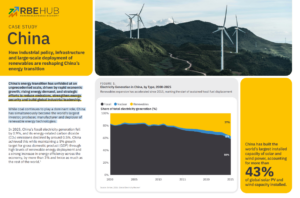
China’s energy transition has unfolded at an unprecedented scale, driven by rapid economic growth, rising energy demand, and strategic efforts to reduce emissions, strengthen energy security and build global industrial leadership.
While coal continues to play a dominant role, China has simultaneously become the world’s largest investor, producer, manufacturer and deployer of renewable energy technologies.
Check out the China Case Study to learn more.
China Case Study links and downloads:
- China Case Study: Available Here
- Figure 1 – Electricity Generation in China, by Type, 2000-2025
- Figure 2 – Installed Electricity Capacity in China, by Technology, 2009-2025
- Figure 3 – China’s Share of Global Manufacturing in Selected Energy Technologies, as of 2025
- Figure 4 – China’s Renewable Energy and Enabling Technology Exports, by Type, 2018-2025
- Figure 5 – Major Policies for Renewable Energy in China, 1986–2026
RBE Tracker Launch Event
REN21 has officially launch the Renewables-Based Economy Tracker, the first global tool designed to track how renewable energy is reshaping economies and societies beyond the power sector.
The event brought together leading voices from across the community to explore why the transition needs new metrics, what the Tracker reveals, and how these insights can help inform better decisions.
Highlights from the event
The launch of the Renewable-Based Economy (RBE) Tracker brought together leaders from across the renewable energy community to explore a critical question: how do we measure progress towards economies powered by renewables?
Speakers highlighted a growing disconnect between rapid renewable energy deployment and the slower pace of broader economic transformation. As REN21 Executive Director Rana Adib noted, renewables now account for the vast majority of new power capacity additions globally, yet fossil fuels still supply most of the world’s energy needs. Participants stressed that the transition can no longer be understood solely through electricity generation or installed capacity. Instead, it must be assessed through its impact on economies, societies and energy-consuming sectors such as transport, buildings and industry.
The discussion underscored the need for a more holistic approach to tracking progress. Speakers emphasised that renewable energy is not only a climate solution but also a driver of resilience, prosperity and improved well-being. Rosilena Lindo highlighted that while renewable deployment is accelerating, “the deeper structural transformation of our economies is struggling to keep pace”, reinforcing the need for new ways of measuring change.
The RBE Tracker is a first-of-its-kind tool designed to capture this broader picture, bringing together economic, social, environmental and energy indicators to help policymakers, businesses and civil society understand how renewables are reshaping economies beyond the power sector.
Dive into the RBE Tracker and Hub
Building on 20 years of the Renewables Global Status Report, the RBE Tracker and Hub move beyond tracking renewable deployment in isolation to exploring how renewables shape economies, societies and energy systems. Bringing together data, insights and visual tools in one place, the Hub offers a more accessible, interactive and collaborative way to understand the transition to renewables-based economies.


