In 2024 Renewable energy deployment continued at a record pace, reinforcing its role as a central pillar of modern energy systems as well as economies and societies. A total of 741 GW of renewable power capacity was added globally in 2024, marking the largest annual increase ever recorded. Yet this rapid growth is unfolding alongside rising energy demand, mixed policy signals and mounting pressure on infrastructure and markets. The result is a transition that is accelerating in scale, but struggling to deliver system-wide change at the speed required.
Demand is rising fast, while fossil fuels still meet the shortfall
Global energy demand rose by 2.2% in 2024, driven by increasing consumption in emerging economies and a 4.3% rise in electricity demand. This increase was led by higher cooling needs, expanding electrification in industry and transport, and the rapid expansion of data centres linked to the surge in artificial intelligence applications and digital infrastructure.
Renewables supplied a large share of this additional demand, but not all of it. Fossil fuels continued to fill part of the gap, dominating global energy supply with an 80% share and contributing to a 0.8% increase in global CO₂ emissions compared with 2023. At the same time, global energy efficiency improvements remained at around 1%, far below the commitment made at COP28 to double the annual improvement rate to 4% by 2030, increasing pressure on energy systems.
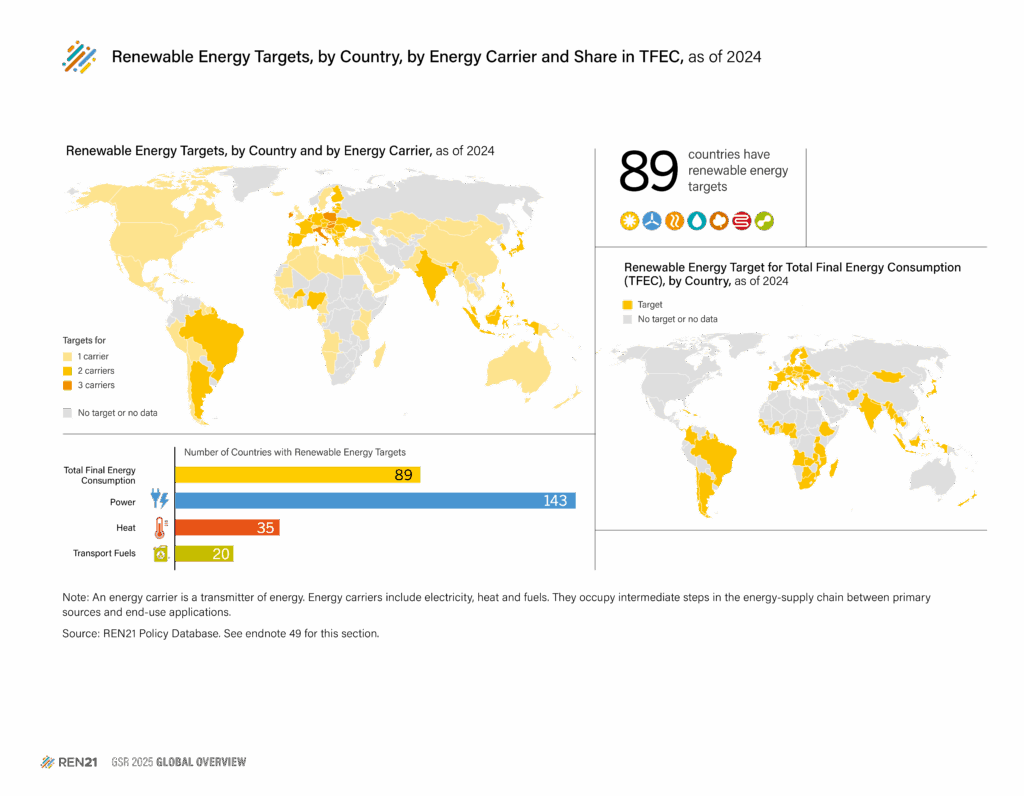
Moreover, only 13.4% of the energy consumed by the main four end-use sectors buildings, industry, transport, and agriculture comes from renewables. As of 2024, only 5 countries had national renewable energy policies for all four end-use sectors, indicating a continued lack of comprehensive policy frameworks to drive renewable energy uptake across demand sectors.

Record power-sector growth, but off track for 2030
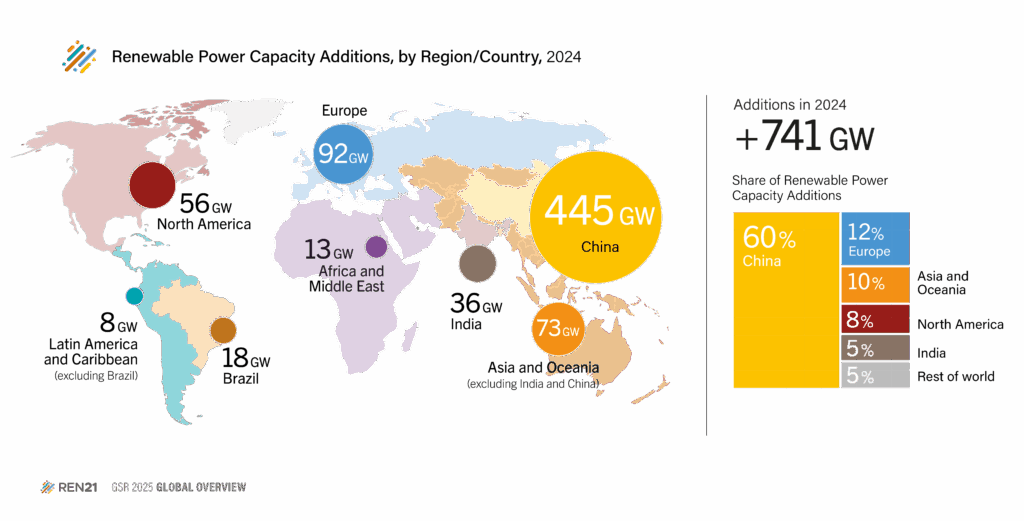
A record-breaking 741 gigawatts of renewable power capacity was added in 2024, by far the largest annual increase to date, with China alone accounting for 60.2% of these additions (445 GW), underscoring the growing concentration of deployment in a small number of markets. Solar PV made up more than three-quarters of new global capacity, driven by falling technology costs and surging demand.
Despite this momentum, current progress remains insufficient to meet the global commitment to triple renewable capacity by 2030. Only solar PV is currently on track to deliver its full contribution, while other technologies are falling behind.
At the same time, progress beyond the power sector remains limited. Heat and fuels account for more than three quarters of total final energy consumption, yet renewables supplied only 10.6% of global heat demand in 2024, while biofuels represented just 3.6% of transport fuel use. This reflects the continued reliance on fossil fuels in heating, cooling and transport, where renewable alternatives have expanded far more slowly than in electricity generation.
Policy gaps and wavering commitments slow progress
Policies and commitments on renewables show uneven progress: while some countries raise ambition through updated targets and supporting policy mechanisms, others are stalling or backtracking. Moreover, policy attention remains focused on the power sector, with renewable heating, cooling and fuels being largely overlooked despite their dominant share in energy demand.
This uneven policy environment is reinforced by weakening private-sector signals. Although new alliances and targets were announced, backsliding by key actors in energy, finance and manufacturing raised concerns about the credibility and durability of private climate and renewable energy leadership. Several major banks withdrew from the Net Zero Banking Alliance during the year, while fossil fuel companies like Equinor, Shell and BP all scaled down their renewable energy strategies in 2024.
Trade policy has added another layer of complexity. The number of trade measures targeting renewables and related technologies jumped from just 9 in 2015 to 212 in 2024, including 51 related to solar PV, 32 for wind and 51 for batteries. These trade measures, while intended to strengthen domestic markets and industries, are also contributing to supply uncertainty and delaying project implementation globally.
“We are deploying renewables in record numbers, but we are not building the systems needed to transition to a renewables-based economy. Without coherent policies, coordinated planning, and resilient infrastructure including grids and storage, even record deployment cannot deliver speedy and lasting transformation. Renewables must now be treated as core economic infrastructure — essential for energy security, resilience and prosperity,” Rana Adib, Executive Director, REN21.
Progress remains uneven across regions and technologies
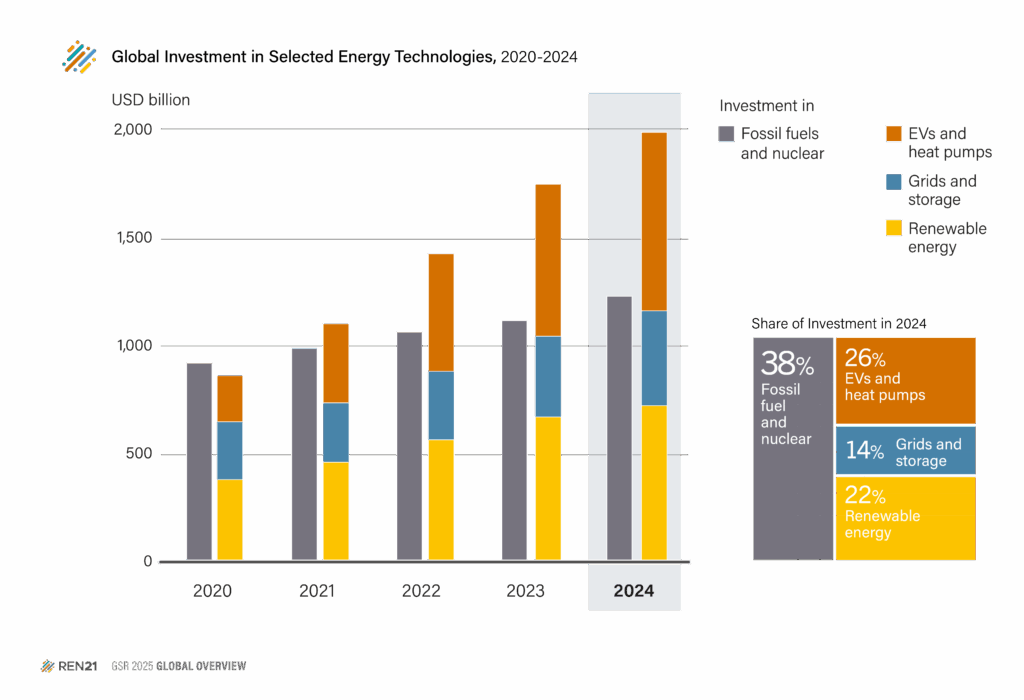
Global investment in renewable energy and enabling technologies reached USD 2.1 trillion in 2024. Investment in renewable energy alone amounted to USD 728 billion, with solar PV attracting USD 521 billion of that total, representing 72% of global total renewable energy investment. A growing share of investment flowed into small-scale and distributed systems like rooftop solar, reflecting the expanding role of decentralised energy solutions. Regionally, China made up the largest share of investment, with USD 290 billion in 2024.
This data shows that investment remains concentrated in a few markets and technologies, while high capital costs continue to limit renewable deployment especially in emerging and developing economies. Yet, between 2020 and 2024, investments in fossil fuels and nuclear energy also grew but at a slower rate; their relative share in total energy investment declined.
Spending on power grids rose 15% to USD 390 billion, while investment in energy storage increased 36% to USD 54 billion, driven largely by developments in Asia, the United States and Europe. Despite this progress, grid investment still falls short of what is needed to support the scale of renewable expansion required for net zero emissions by mid-century.
“The energy transition is an opportunity to transform the foundations of our economies. Renewables are a catalyst for systemic change, but only if governments, investors and organisations align behind long-term strategies rather than short-term signals. Systemic change means moving beyond targets to implementation across institutions, sectors and policies,” Ramón Méndez Galain, President of REN21 and former Energy Secretary of Uruguay.